
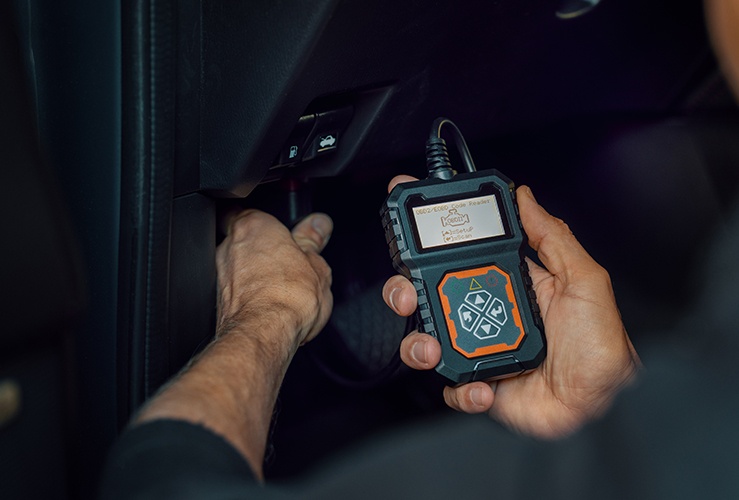
For most drivers, the sudden appearance of the check engine light is both worrying and frustrating. It gives no clear explanation — just a small symbol glowing amber on the dashboard. This is where an OBD-II scanner becomes invaluable. These devices give you access to the same car diagnostic information that mechanics and dealerships use, helping you understand what’s going on under the bonnet. But before you rush out to buy one, there are a few important things you really need to know about how they work, what they can do, and where their limits lie.
A Quick Overview of OBD-II
OBD stands for “On-Board Diagnostics,” and OBD-II is the second generation of this system, made mandatory as part of legislation in Europe and the UK from 2001 for petrol cars and from 2004 for diesels. Every compliant vehicle has a standardised 16-pin port, usually located beneath the steering wheel. When you plug a scanner into this port, it communicates with the car’s electronic control unit (ECU), retrieving diagnostic trouble codes and live data.
These codes follow a universal format, which means an OBD-II scanner can be used on virtually any modern car. That said, the OBD-II protocol can only read the engine and transmission systems. Other systems such as ABS, airbags, Battery Management System (BMS), will not be possible unless you have a tool that supports proprietary manufacturer protocols.
What OBD-II Scanners Can Do
The most common use of an OBD-II scanner is to read and clear fault codes. These are often displayed as “P-codes” (for powertrain), such as P0300 for a random misfire. Alongside the code, many scanners provide a short description of the fault, which makes it easier to understand.
Beyond just codes, scanners can also show live data from the car’s sensors — things like oxygen sensor readings, engine temperature, fuel trim, or mass airflow. Monitoring these values in real time can help identify problems that don’t immediately trigger a fault code. Some scanners also display freeze-frame data, which is a snapshot of conditions at the moment a fault occurred.
Another useful feature is checking “readiness monitors.” These indicate whether the car’s onboard tests for emissions systems have completed. If they haven’t, it could cause an MOT failure even if no warning lights are currently on.
The Different Types of Scanners
OBD-II scanners come in several forms. Basic handheld code readers are simple, affordable, and do the essentials — reading and clearing engine codes. They are perfect for occasional use or for keeping in the glovebox.
Mid-range and professional scanners provide wider system coverage and extra features. These can access ABS, airbags, and service functions like resetting oil lights, injector coding and performing a DPF regeneration. High-end devices, often used by workshops are bi-directional and can run advanced component tests and even perform coding or adaptations on replacement parts.
The Limitations to Keep in Mind
It’s important to understand what an OBD-II scanner cannot do. A fault code does not tell you exactly which part to replace — it only highlights the system where the problem was detected. For example, a code pointing to an oxygen sensor could be caused by the sensor itself, but it might also be a wiring fault, a vacuum leak, or an exhaust issue. Proper diagnosis requires interpretation of the data, not just reading the code.
Another limitation is that not all scanners provide the same level of access. Generic OBD-II devices may only cover the engine and transmission, while advanced tools support manufacturer specific protocols to give you deeper scanning and comprehensive diagnostics for other systems. Before buying, always check what your specific vehicle and needs require.
Why It’s Worth Owning One
Despite these limitations, an OBD-II scanner is a very useful tool for any driver. It can save time, reduce anxiety, and help you decide whether a warning light is something urgent or something that can wait. For DIY enthusiasts, it adds a level of insight that makes troubleshooting much easier. For everyone else, it can at least provide clarity before visiting a garage.
